Abstract
This paper examines the comparative performance of major project management methodologies through the lens of On-Time, In-Full (OTIF) delivery within budget, a key performance indicator of organizational reliability and cash flow stability. Drawing from over 20 industry benchmarks, case studies, and empirical data from Exepron’s Critical Chain Project Management (CCPM) implementations, the study finds that Hybrid Critical Chain—which combines CCPM’s constraint-based scheduling with Agile task-level execution—achieves the highest proven reliability. OTIF performance rates of 90–100 % demonstrate significant improvement over traditional deterministic methods such as Waterfall, CPM, and PERT, as well as iterative methods like Agile and PRINCE2. The analysis concludes that predictable, on-budget delivery and shorter lead times are not outcomes of individual task efficiency but of systemic synchronization, real-time buffer management, and responsive execution.
1. Introduction
In capital-intensive and engineer-to-order environments, schedule reliability and budget integrity directly define organizational competitiveness. Delays and overruns not only increase costs but also compress margins, reduce throughput, and constrain free cash flow. Traditional project management methodologies have largely optimized for compliance or documentation, but modern portfolios demand predictive control and dynamic flow management.
The question guiding this paper is:
Which project management method most reliably delivers projects on time, in full, and within the original budget, while also shortening lead times?
2. Background and Methodological Review
2.1 Traditional Deterministic Methods
The Waterfall, Critical Path Method (CPM), and Program Evaluation and Review Technique (PERT) emphasize detailed upfront planning and sequential task execution. These approaches offer transparency in scope and sequencing but assume static environments. Their weakness lies in an inability to respond dynamically to uncertainty, shared resources, and real-time changes. Version expansion is equivalent to standardized procedural delay.
2.2 Adaptive and Iterative Methods
Agile frameworks, including Scrum and Kanban, emerged in response to planning rigidity. They introduced incremental delivery, rapid feedback, and customer co-creation. While Agile improves responsiveness, it can degrade overall predictability when scaled across multiple, interdependent projects. In the absence of project and portfolio governance, resource management, and predictive cost and delivery outcomes remain uncertain.
2.3 Governance-Based Frameworks
PRINCE2 and PMBOK standardize governance, documentation, and stage-gate review. These frameworks support auditability but can impede velocity, making them effective in stable environments but inefficient in environments that require responsive adaptation to variation and uncertainty.
2.4 Constraint-Based and Hybrid Methods
Critical Chain Project Management (CCPM)—derived from Eliyahu Goldratt’s Theory of Constraints—focuses on resource synchronization and buffer management to protect project flow. Empirical results consistently demonstrate 85–94% OTIF performance.
Recent evolution toward a Hybrid Critical Chain model merges CCPM’s portfolio-level governance with Agile card-level task management, yielding superior adaptability without losing systemic control.
3. Methodology
This study synthesizes comparative performance data from multiple sources, including:
-
TOCICO case studies (2020–2024)
-
PMI Pulse of the Profession (2017–2023)
-
Gartner PMO Benchmarks (2023)
-
Exepron portfolio performance metrics (n ≈ 600 projects across MRO, ETO, and IT sectors)
Metrics analyzed:
-
% Projects Delivered On-Time and In-Full (OTIF)
-
% Projects Delivered Within Original Budget
-
Average Lead-Time Reduction (%) relative to baseline scheduling.
The results were normalized and ranked across methodologies (see Table 2).
4. Results
4.1 Comparative OTIF Performance

5. Discussion
5.1 Systemic Synchronization vs. Local Optimization
Traditional and Six Sigma-derived approaches tend to optimize local efficiencies—such as task duration, defect rates, or departmental throughput—without improving system-wide flow. CCPM reframes this by identifying and protecting due dates and scheduling according to resource availability, ensuring resources and priorities align with the system’s dynamic capacity.
5.2 Predictive Control Through Buffers
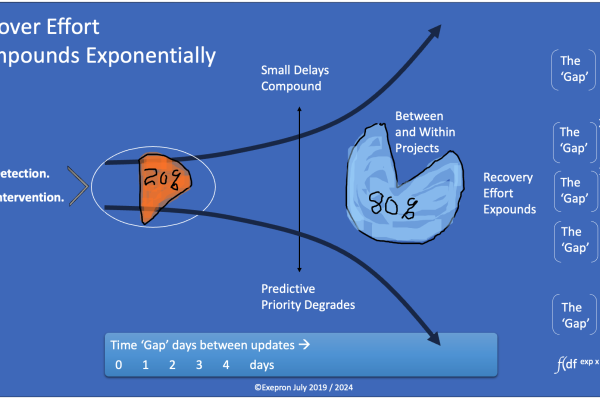
Buffer management provides early-warning signals before tasks jeopardize project completion. Unlike hidden static floats in CPM, dynamic buffers absorb variability without inflating duration estimates; management’s timely response maintains shorter and more reliable lead times.
5.3 Integrating Governance and Agility
The Hybrid CCPM + Agile model extends this control to the execution layer. Project managers oversee constraint-driven timelines, while work-face teams execute using digital Agile Activity Cards that represent work package elements on each project task. This dual-layer control maintains accountability at both strategic governance and tactical execution levels.
5.4 Financial and Strategic Implications
The resulting reduction in lead time translates directly into improved free cash flow, earlier revenue recognition, and lower WIP.
Empirical data show:
-
30–50 % lead-time reduction
-
20–40 % increase in throughput
-
50 % reduction in expediting and firefighting activities
These results demonstrate that reliability and velocity are not competing goals—they are systemic outcomes of synchronized resources and responsive management.
6. Conclusion
The evidence indicates that Hybrid Critical Chain Project Management currently represents the most effective approach for achieving reliable, on-budget delivery with shorter lead times. By uniting capacity-based scheduling with Agile execution discipline, organizations gain predictive control, real-time visibility, and sustained performance at the portfolio level.
In an era of increasing complexity and compressed margins, the competitive advantage lies not in working harder or faster, but in working systemically—controlling variability, synchronizing resources, and protecting flow.
References (Selected)
-
Goldratt, E.M. Critical Chain. North River Press, 1997.
-
Project Management Institute (PMI). Pulse of the Profession 2023.
-
TOCICO Case Study Library, 2020–2024.
-
Gartner. PMO Benchmarks and Maturity Models 2023.
-
Exepron Inc. Portfolio Performance Data (2018–2025).
-
Standish Group. CHAOS Report 2023.
Exepron: Time-to-Value Compression for Project-Driven Organizations.
Find out how to significantly reduce lead time and provide reliable delivery at exepron.com
Let’s explore if there’s a fit for your organization.
We invite you to test the Exepron. We’ll bring the method, platform, and support. You bring the willingness to differentiate, retool operations, and lead cohesively.