Delay destroys value at exactly the rate the project portfolio was supposed to create it.
Why One Late Project Can Destroy the Profit of an Entire Portfolio
Most organizations underestimate the cost of a delayed project.
 They calculate the extra labor days, the overhead burn, perhaps a penalty clause or two. The number is uncomfortable, but manageable.
What almost no one calculates is the financial domino effect. Typically, all resources are not in abundant surplus; they are scarce and shared.
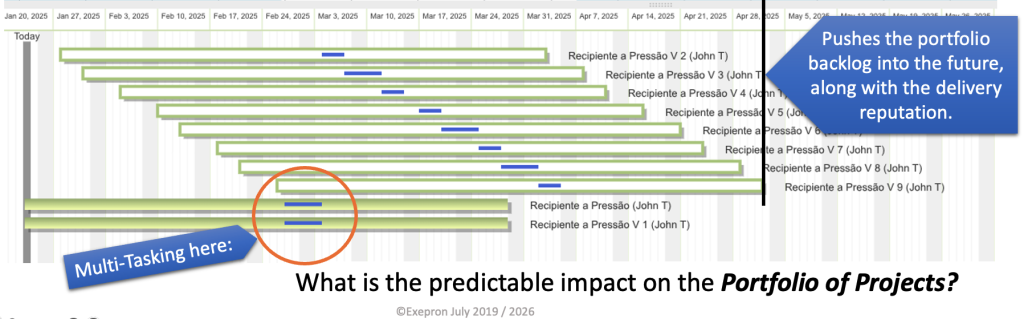
When projects share scarce resources—as they do in almost every engineering, manufacturing, construction, and technology organization—a delay is never isolated. One slipping project pushes every downstream project into the future before those projects have even begun. A domino effect.
What looks like a minor schedule issue inside one project quietly becomes a system-wide financial event.
And when the mathematics are examined correctly, the economic damage is often orders of magnitude larger than conventional accounting suggests.
The Standalone Project Fallacy
Traditional project accounting treats each project as an independent economic unit.
Managers calculate the cost of delay using straightforward arithmetic: additional daily costs multiplied by the number of delayed days. The logic seems reasonable.
But it contains a critical flaw.
Projects rarely operate in isolation. They share engineers, equipment, specialists, and decision-makers. These resources take turns and act as potential true constraints of the organization. When one project occupies them longer than planned, the next project is disrupted, slowed, and occasionally halted.
The result is simple but profound:
A delay in one project is likely to push the entire project pipeline back.
A 20% delay on the first project is not merely a 20% delay on that project.
It’s a potential 20% delay on every project waiting in the queue.
In organizations running multiple initiatives from the same resource pool, delays cascade through the entire portfolio like falling dominoes.
The Pipeline Cascade
Consider a simple example.
Five projects are scheduled in sequence, each relying on the same core engineering team. Each project is planned to run for 180 days, with staggered start dates so that resources transition smoothly from one project to the next.
Now introduce a 36-day accumulated delay in the first project.
The consequences are immediate.
Project 2 cannot continue until the shared resources are released.
Project 3 cannot continue until Project 2 finishes using specific common resources.
Projects 4 and 5 are now delayed before they have even started.
The entire pipeline has shifted.
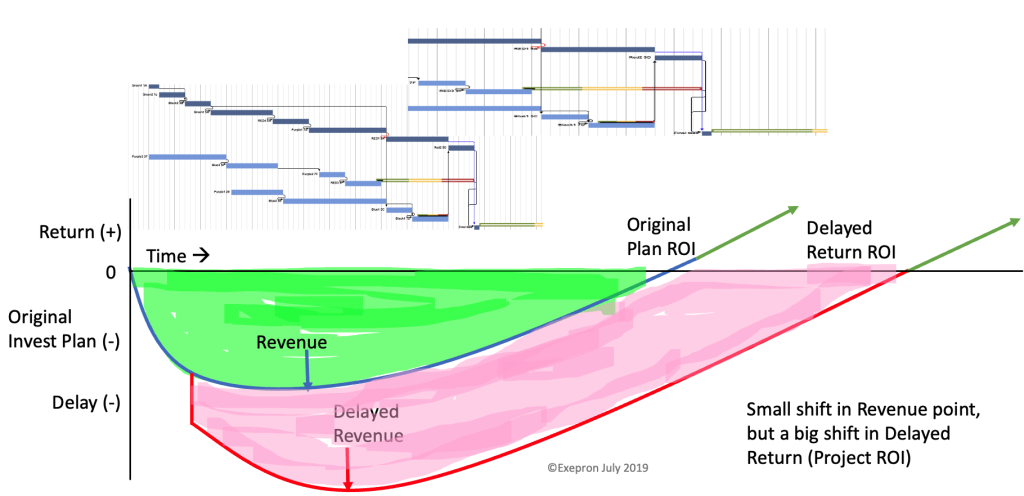
What appeared to be a small disruption in one project has quietly pushed the organization’s entire portfolio of returns into the future.
This is the Pipeline Cascade Effect.
The Multiplier Nobody Calculates
Once the cascading delay is recognized, a second effect becomes visible.
Each delayed day does not simply affect the original project—it affects every project downstream.
The financial multiplier is therefore:
Pipeline Cascade Multiplier (M)
M = 1 + n
Where n is the number of downstream projects pushed by the delay.
If five projects depend on the same resources, the multiplier becomes 6×.
This means that each delayed day costs six times as much as the standalone project calculation would suggest.
Suddenly, the accounting arithmetic changes dramatically.
What managers thought was a manageable delay becomes a portfolio-level financial event.
Why WACC Is the Wrong Measure
Most financial models attempt to estimate the cost of delay using the company’s Weighted Average Cost of Capital (WACC).
This is understandable—and wrong.
WACC measures the cost of generic capital in the marketplace. But the capital tied up in a delayed project was not intended for generic investment. It was intended for the next approved project in the pipeline.
That project was approved precisely because it offered a return well above WACC.
In many project environments, the expected return on the project (Project ROI) over its duration can exceed 200%, translating to roughly 1.1% per day.
Compare that with a typical WACC of 15% annually—approximately 0.04% per day.
The difference is staggering.
Using WACC understates the true cost of delay by as much as 28 times.
The correct compounding rate is therefore the project’s own expected return, because that is the opportunity cost of capital locked inside the delay. It is the cost of lost opportunity, not WACC.
The Compounding Destruction of Value
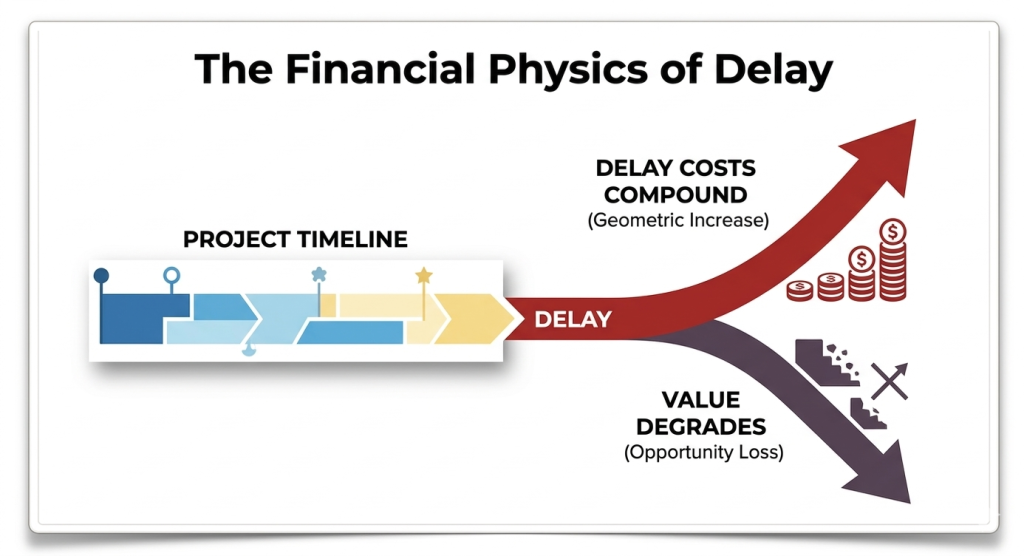
Delay triggers two simultaneous financial forces.
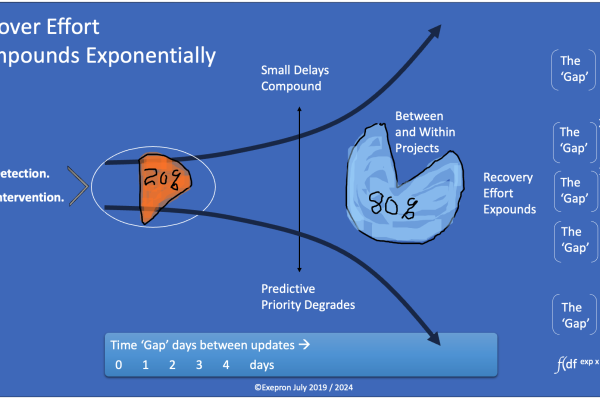
First, costs compound upward.
Every delayed day continues to consume fixed labor and overhead while simultaneously preventing the capital from generating its expected return in the next project.
Second, Contribution Margin erodes downward.
Customers lose patience. Competitors step in. Contracts are renegotiated. Delivery value declines over time.
In effect:
Delay destroys value at exactly the rate the project was supposed to create it.
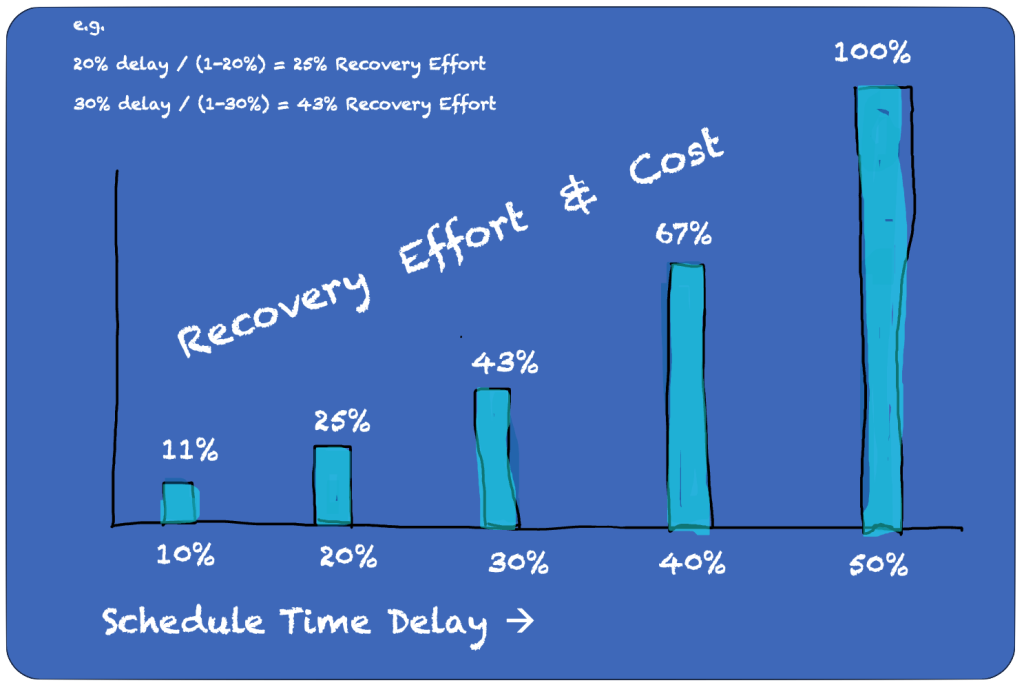
This is why the financial impact of delay accelerates so rapidly. The recovery effort must grow faster than the delay itself because the opportunity loss compounds daily.
Why Organizations Rarely See The True Impact
Despite the magnitude of the financial impact, the pipeline cascade effect remains largely invisible inside most companies.
Three structural blind spots explain why.
1. Project accounting is isolated.
The cost imposed on downstream projects does not appear in the delayed project’s budget. The faulty assumption of independence, yet a shared resource pool?
2. Post-mortems are retrospective.
Organizations analyze what went wrong inside a project but rarely examine the portfolio-level consequences. Not considering “What caused most delays on most projects most of the time?”
3. Resource contention is treated as scheduling.
Managers debate Gantt charts and task dependencies rather than calculating the financial cost of displaced capital use.
As a result, the true cost of delay appears in nobody’s budget, yet it affects everyone’s bonuses.
The Strategic Implication for CFOs
Once the pipeline perspective is adopted, several strategic conclusions become unavoidable.
First, recovery spending should be far more aggressive than traditional project management allows. If the cascade multiplier is 6x, then rational recovery spending can cover up to 6 times the standalone delay cost.
Second, the project requiring immediate intervention is not necessarily the largest—it is the one with the greatest downstream pipeline impact.
Third, time buffers are not a waste.
Buffers are financial insurance against cascade risk. When valued correctly, a single protected day in the schedule can be worth multiples of its apparent cost. They provide protection for uncertainty risk and prioritization for timely and cost-effective intervention.
The Hidden Economic Lever
Every CFO intuitively understands that delays harm cash flow.
What is less widely recognized is how quickly the damage compounds when projects share resources.
The correct model is not a standalone project—it is a continuous pipeline of capital deployments.
When that pipeline stalls, value destruction accelerates faster than most financial models assume it will recover.
Which leads to a provocative but accurate conclusion:
In project-driven organizations, the real cost of delay is rarely the delayed project itself.
It is the entire portfolio of opportunities that now arrive late.
And once the cascade begins, the financial dominoes fall faster than anyone expects.
Download a whitepaper, “Cost of Delay,” and a spreadsheet model of the analysis.
Contact Exepron here to understand how this capital model applies to your environment.
About the Author
John L. Thompson is COO and co-founder of Exepron and a practitioner of the Theory of Constraints with over 40 years of experience helping organizations improve flow, reduce lead times, and increase Asset Productivity.
email: JohnT@Exepron.com
Exepron: for Logistic-Driven Organizations.
Find out how to significantly reduce lead time and provide reliable delivery at exepron.com
Let’s explore if there’s a fit for your organization.
We invite you to test the Exepron. We’ll bring the method, platform, and support. You bring the willingness to differentiate, retool operations, and lead cohesively.