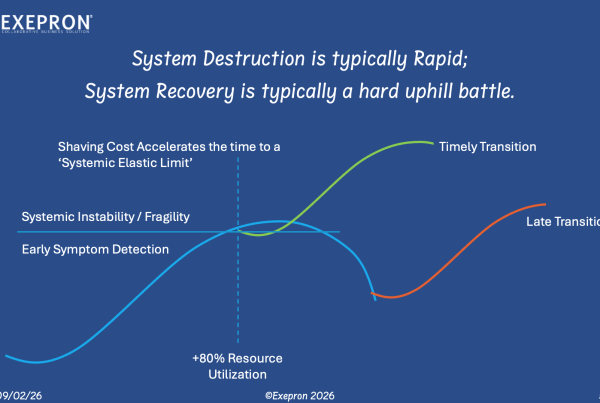
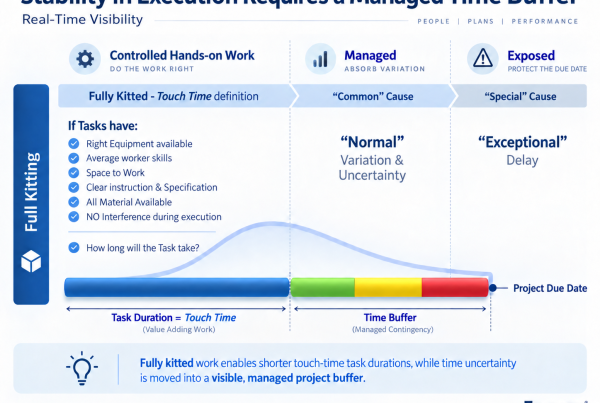
Most project professionals would instinctively claim that the last 20% of a project’s life is when everything is urgent. It feels obvious. Late in the job, options are fewer, stakeholders are tense, milestones are close, and every lost day causes visible damage. That is true. A late-stage delay is painful.
But here is the more dangerous mistake:
Believing an early delay is less damaging because “we’ll make it up later.”
That assumption is what quietly destroys projects.
A delay in the first 20% does not stay contained in the first 20%.
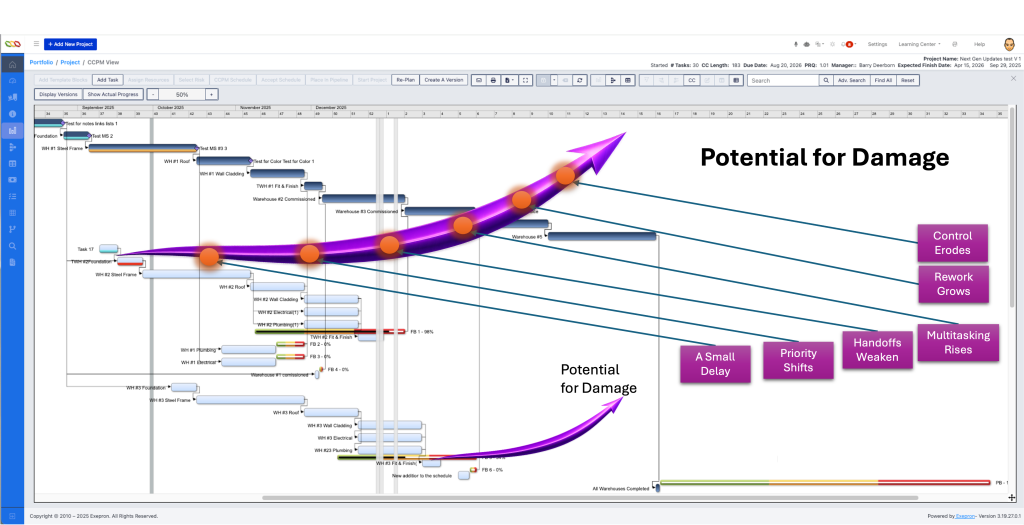 An early delay changes the conditions under which everything else must now be executed.
Crews get shifted. Handoffs become rougher. Successor tasks start with less clarity. Priorities get scrambled. Managers begin asking for acceleration. Resources are multitasked. Quality slips. Rework enters. The project is no longer running on the original plan. It is now running as a disturbed system. That is the real damage. The delay is not just one late task. It becomes a chain reaction.
This is where traditional schedule thinking often misleads teams. On paper, a three-day slip in month one looks easier to absorb than a three-day slip near the end of the 6-month project. In reality, early delay often creates the conditions for many more delays later. Why? Because recovery is rarely free. There are penalties for recovery.
Gains are infrequent and do not propagate down the entire dependency chain; delays definitely do.
“Making up time” usually means overtime, overlapping work, switching people between priorities, rushing decisions, compressing handoffs, and pushing incomplete work forward. Each of those actions adds friction and variability, not control. The result is that the original delay compounds as it propagates through the network rather than disappearing.
The deeper problem is the gain/loss asymmetry. Gains do not compound the way delays do. If one task finishes early, the next crew usually does not magically arrive early. Materials do not suddenly advance. Approvals do not accelerate just because a predecessor finished ahead of plan. But when a task finishes late, the disruption absolutely does move forward. That is why real projects tend to have a long right tail of delay rather than a neat bell curve around the plan. In simple terms, early gains are often local, but early delays are transmitted down the chain.
So, which is more damaging?
The honest answer is this:
A late delay is more visibly dangerous.
An early delay is often more strategically costly and much more damaging.
Late delay hurts because recovery options are exhausted. Early delay hurts because conventional thinking believes recovery is still easy. That belief triggers the very behaviors that make the project unstable later.
The behavior that ignores early intervention is definitely not the behavior required to finish a project on time and on budget.
For PMOs and project managers, the practical lesson is straightforward:
Do not treat early slippage as harmless float or buffer consumption. Treat it as a warning that execution conditions are about to degrade. The lack of operational discipline that downplayed the early slippage is not the discipline that will deliver on time and on budget.
Ask different questions early:
- What successor work is now at risk?
- Which handoffs just got harder?
- Where will multitasking increase?
- Which teams will be forced into stop-start work?
- What quality or rework risk just went up?
- Will the recovery action create more damage than it removes?
The goal is not to “push harder.” The goal is to protect the flow before a single small delay becomes a cascade of 10 secondary disruptions. This is within just one project; what happens to the rest of the portfolio of projects sharing the same resource pool?
That is the myth worth dispelling:
Projects do not usually recover from early delay by “making up time later.”
More often, they pay for it later with compounding disruption, lower-quality execution, more rework, and a schedule that becomes less trustworthy every week.
Researching your own project’s performance will most likely reveal project variance overlooked the hidden effects of handoff delays, context switching, rework, planning bias, and chain amplification.
Bottom line:
If you want to protect a project, do not wait until the last 20% to expedite.
The most expensive delay may be the one dismissed in the first 20%.
Contact Exepron here to understand how this applies to your environment.
About the Author
John L. Thompson is COO and co-founder of Exepron and a practitioner of the Theory of Constraints with over 40 years of experience helping organizations improve flow, reduce lead times, and increase Asset Productivity.
email: JohnT@Exepron.com
Exepron: for Logistic-Driven Organizations.
Find out how to significantly reduce lead time and provide reliable delivery at exepron.com
Let’s explore if there’s a fit for your organization.
We invite you to test the Exepron. We’ll bring the method, the technology, and the support. You bring the willingness to differentiate, retool operations, and lead cohesively.