Lack of communication is rarely the cause of project delays. It is usually the visible symptom of an unstable project structure.
A call for communication feels reasonable because the symptoms they observe are:
- Teams and resources are progressively not aligned
- The project status is progressively unclear
- Resources are increasingly conflicted
- Priorities constantly change
However, these are typically symptoms of a deeper structural problem rather than the root cause.
Without preparation to manage variability, project networks rapidly become unstable, and managers lose visibility and predictability.
Managers see:
- tasks starting but not finishing
- resources pulled in multiple directions
- milestones constantly moving
- conflicting priorities
To regain control, the instinctive reaction is to increase:
- more meetings
- more reporting
- more status dashboards
- more coordination calls
The assumption is that more information will restore control.
Unfortunately, in complex project networks, the opposite occurs.
Why These Solutions are inadequate
1. Communication Overload
When the network contains too many interdependent tasks, the number of coordination interactions increases rapidly.
Each task dependency requires communication between people, teams, or departments. As the task network grows denser, communication demand outpaces the organization’s ability to process it.
Instead of clarity, teams experience communication noise.
2. Reporting is Lagging Information
History is the past; it cannot predict the future. Detailed reporting often tracks task completion status and delays; by the time problems appear in reports, the delays have already propagated throughout the future network.
Managers are reacting to historical information, not controlling the system.
3. Resource Management Becomes Reactive
When WIP is excessive and tasks are highly detailed, every resource appears overloaded.
Schedulers attempt to solve this by:
- reallocating engineers
- shifting priorities
- splitting work across multiple projects
This creates multitasking, which slows completion and increases delays.
The more resources are shuffled, the more instability spreads.
The Structural Root Cause
The real issue is usually network coupling, resource contention, and excessive WIP, caused by schedules that contain:
- too many small tasks, micro tasking
- dense dependency networks, and worse, missing dependencies
- unmanaged hidden variation within tasks
- ignored resource contention when planning
- uncontrolled work release
Under these conditions, the project behaves like a tightly coupled system.
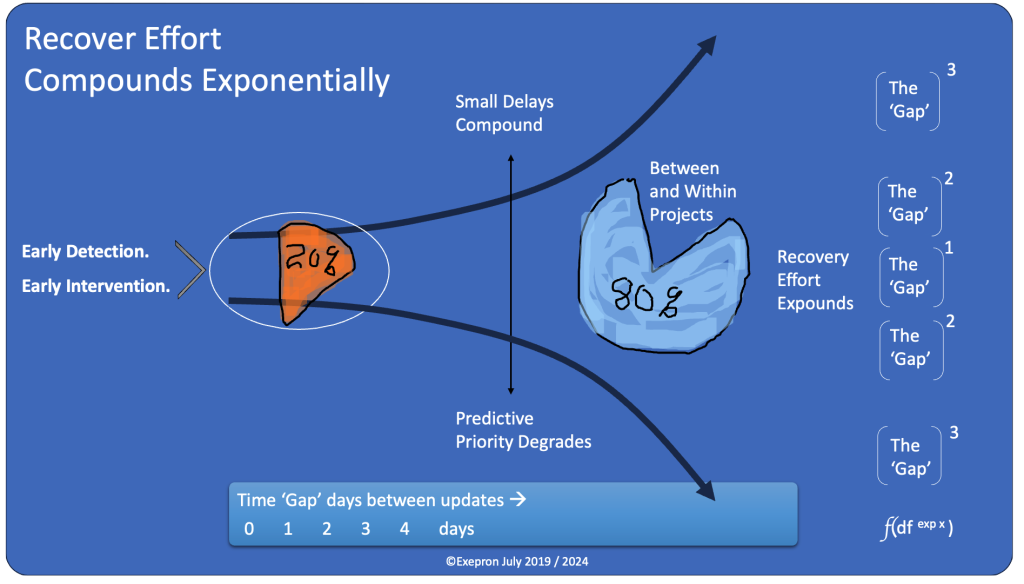
The speed of delay propagation is greater than the speed of communication.
Small delays propagate rapidly, and no amount of additional communication can stabilize the network.
Why Structural Solutions Work
Instead of increasing reporting or coordination, effective project systems focus on structural stability, that is, preparing projects to manage variation and uncertainty.
This involves:
- aggregating tasks into work packages
- limiting WIP by staggering the workload according to resource availability
- pooling safety times into visible tactical buffers to manage uncertainty
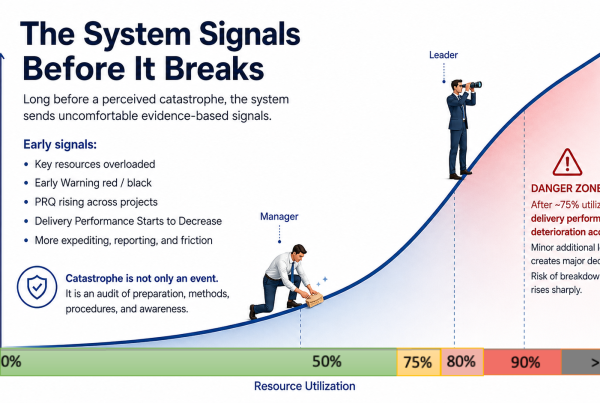
- monitoring and responding to system signals:
Red Task, Early Warning, WIP overload, Risk Quotient.
These structural changes reduce the number of interactions that must be coordinated.
Once the system stabilizes, communication naturally improves because teams are no longer constantly resolving conflicts.
The Key Insight
Better communication does not fix unstable systems—stable systems naturally produce better communication.
Executive Summary
Managers often try to fix delays with better communication, more reporting, and tighter resource control. These responses address symptoms, not causes.
When schedules contain too many interdependent tasks and excessive WIP, the project becomes tightly coupled and unstable. Communication overload, reporting noise, and resource conflicts naturally follow.
Stability is restored not by increasing coordination but by simplifying the network, aggregating variation into buffers, and controlling flow through system signals.
Reliable execution comes from Three Layers of Aggregation:
- Network Simplification – aggregate micro-tasks into meaningful work packages to gain control, reduce coupling, and WIP.
- Variation Pooling – aggregate uncertainty into managed Time Buffers, rather than unmanaged hiding safety in every task.
- Signal-Based Control – monitor critical signals rather than thousands of task updates.
When these three layers are in place, managers can stop reacting to noise and start responding to critical signals.
Contact Exepron here to understand how the 3-layer model applies to your environment.
About the Author
John L. Thompson is COO and co-founder of Exepron and a practitioner of the Theory of Constraints with over 40 years of experience helping organizations improve flow, reduce lead times, and increase Asset Productivity.
email: JohnT@Exepron.com
Exepron: for Logistic-Driven Organizations.
Find out how to significantly reduce lead time and provide reliable delivery at exepron.com
Let’s explore if there’s a fit for your organization.
We invite you to test the Exepron. We’ll bring the method, platform, and support. You bring the willingness to differentiate, retool operations, and lead cohesively.