From time to time, we receive questions that illustrate this point:
Here are two of those questions:
1/ I have been exploring the PERT function or view with my project, but I am not seeing anything that resembles a true PERT with options for Optimistic Duration, Most Likely Duration, Pessimistic Duration, as well as formulas for Mean Expected Time (TE) and Time Variance (TV). With the ability to chart Early Start, Early Finish, Late Start, and Late Finish, I can discern available slack. With these inputs, I can build a scatter plot (have done in Excel). I realize this is getting into methods that are well outside CCPM, but we felt it was worth asking in case these exist.
2/ Another concept makes use of a Tradespace®. This is where the Pareto Frontier comes in as I had briefly brought up.
Here is an answer; consider it slightly complex to match the original tone:
On Tradespace® and Pareto Frontier analysis:
- Tradespace®/Pareto analysis is a valid method for comparing strategic alternatives.
- It is useful when evaluating trade-offs in engineering design between:
- Cost
- Schedule
- Risk
- Scope
- Technical performance
- Resource demand
Exepron CCPM approaches this differently.
- Exepron does not require a separate theoretical optimization model before the schedule becomes useful.
- CCPM logic already forces the key trade-offs into the plan:
- Resource limitations
- Project priority
- Task sequence
- Buffer protection
- Resource predictive loading
- Project Risk Quotient
- Portfolio impact
The Exepron method is practical rather than theoretical:
- Build the project around realistic touch-time.
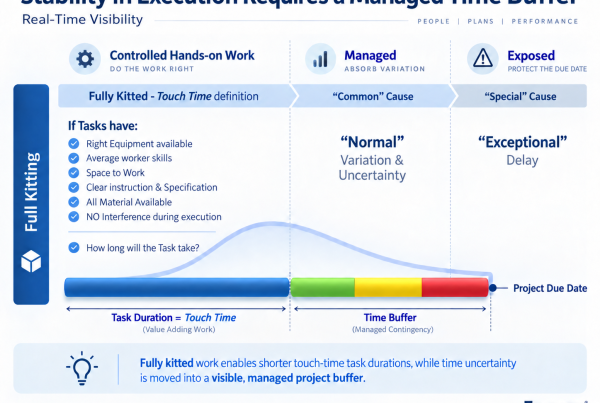
- Apply full Kitting, approvals, space, equipment, instruction, and skill are in place.
- Remove hidden safety from individual tasks.
- Protect the project with visible buffers.
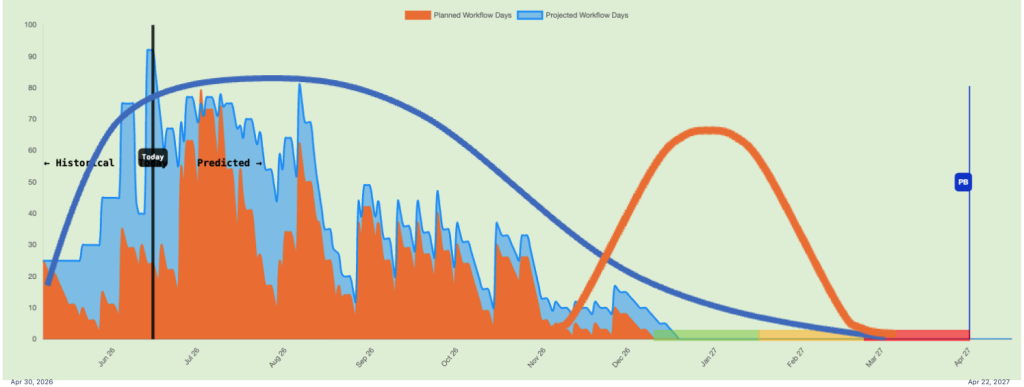
- Test the plan against actual resource availability.
- Update frequently for a realistic intelligence guiding effective decisions
- Monitor execution using buffer consumption, PRQ, and resource loading.
- Intervene early when the project or portfolio begins to consume protection faster than expected.
So instead of asking:
“Which option is mathematically optimal on a Pareto Frontier?”
Exepron asks:
“Which plan can be executed reliably with the available resources, visible protection, and current portfolio load?”
This is the practical difference.
Tradespace® analysis may help compare alternatives before the execution plan is selected. Exepron then takes the selected option and tests whether it is executable under real resource limits and uncertainty.
Today, Exepron primarily uses finish-to-start logic to keep the network simple, stable, and executable. We are also working on a partial-start capability, requested by shipbuilders and other complex project environments. This is valid when work can begin before the predecessor is fully complete, but it must be handled carefully to avoid reintroducing assumed accuracy or unnecessary planning complexity.
Bottom line:
- Tradespace®/Pareto analysis helps compare options.
- Exepron CCPM validates and controls execution.
- The goal is not theoretical optimization.
- The goal is a reliable plan that can withstand uncertainty, resource constraints, and real-world execution conditions.
Contact Exepron here to understand how this applies to your environment.
About the Author
John L. Thompson is COO and co-founder of Exepron and a practitioner of the Theory of Constraints with over 40 years of experience helping organizations improve flow, reduce lead times, and increase Asset Productivity.
email: JohnT@Exepron.com
Exepron: for Logistic-Driven Organizations.
Find out how to significantly reduce lead time and provide reliable delivery at exepron.com
Let’s explore if there’s a fit for your organization.
We invite you to test the Exepron. We’ll bring the method, the technology, and the support. You bring the willingness to differentiate, retool operations, and lead cohesively.