Shorter Touch Time Requires Management Support
Short task durations cannot simply be demanded from employees. They must be enabled by management.
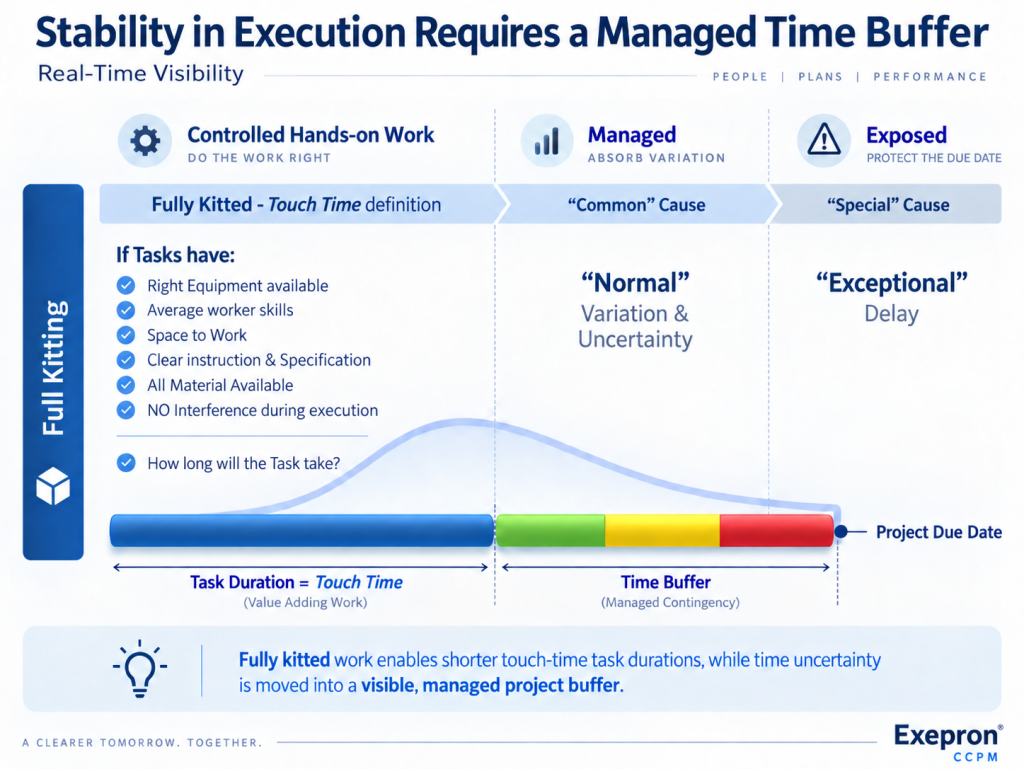
Touch Time is the focused, hands-on time required to complete a task when everything necessary for successful execution is available. This means the correct materials, equipment, workspace, skills, instructions, specifications, approvals, and predecessor work must be ready before the task begins. The employee must also be protected from unnecessary interruptions and competing priorities.
Predictability starts with Task Full Kitting.
When tasks begin without a complete kit, employees must search for information, wait for materials, resolve unclear requirements, switch between assignments, or correct avoidable errors. Missed Full Kitting Item delays are often recorded as task duration—but they are not productive work. They reflect management and process failures. Capture these delay events at the Task level, as Reason Codes for analysis to help eliminate these preventable items from projects.
Management therefore has a direct responsibility to create the conditions for shorter, reliable Touch Time:
- Define clear task scope and completion criteria.
- Confirm that all materials, information, approvals, skills, equipment, and workspace are available.
- Resolve dependencies before releasing the task.
- Protect skilled engineers, technicians, and valuable resources from unnecessary multitasking and interruptions.
- Separate true work time from waiting, rework, and preventable delay.
Once tasks are fully kitted, you can plan their durations using realistic Touch Time. Normal variation and uncertainty should not be hidden inside every task estimate. Instead, this uncertainty is aggregated and protected by a visible, managed time buffer.
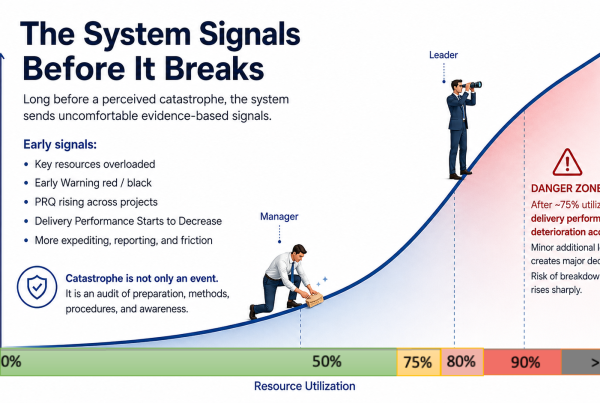
The buffer provides project-level stability and real-time visibility. It absorbs normal variation while exposing exceptional delays that require management intervention. Monitoring Buffer Penetration, Resource Overload, and Reason Code Analysis gives Management timely warning where and when intervention is required.
The principle is straightforward:
Management cannot require shorter task durations without first ensuring that employees are fully prepared and protected to execute successfully.
Shorter Touch Time is not achieved by applying more pressure. It comes from better preparation, controlled task release, focused execution, tracking early warning signals, and disciplined buffer management.
Contact Exepron and understand how this can be applied to your environment.
About the Author
John L. Thompson is COO and co-founder of Exepron and a practitioner of the Theory of Constraints with over 40 years of experience helping organizations improve flow, reduce lead times, and increase Asset Productivity.
email: JohnT@Exepron.com
Exepron: for Logistics-Driven Organizations.
Find out how to significantly reduce lead time and provide reliable delivery at exepron.com
Let’s explore if there’s a fit for your organization.
We invite you to test Exepron. We’ll bring the method, the technology, and the support. You bring the willingness to differentiate, retool operations, and lead cohesively.