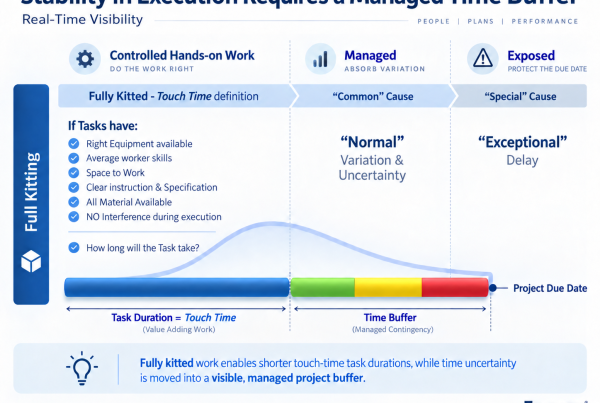
Stakeholders have their own reasons for supporting transformation—or resisting it.
Resistance to change is completely rational when rewards aren’t aligned, even after communication, agreement, and sign-off.
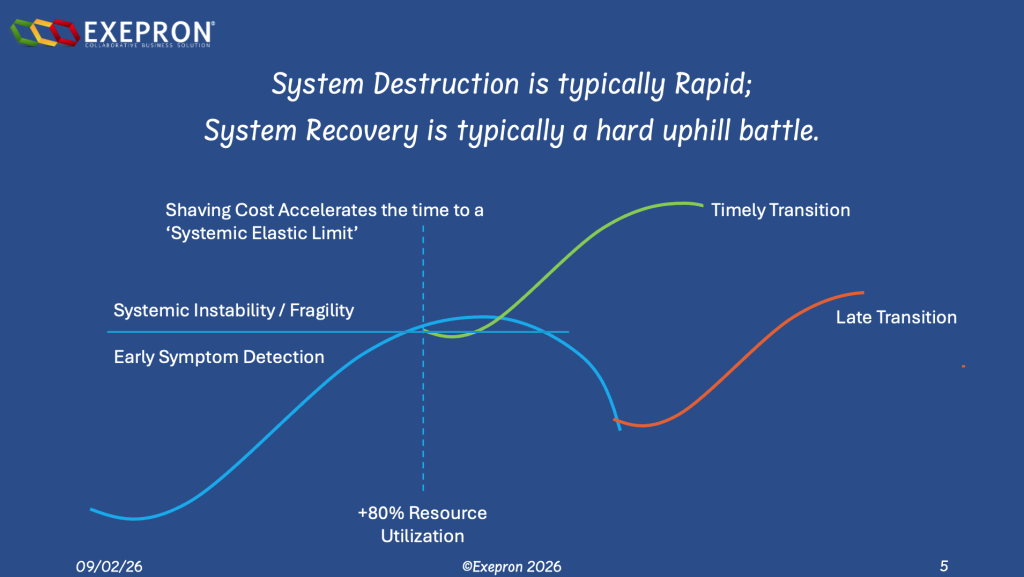
GLOBAL:
Owners and executives are generally measured against global results: corporate operating profit, cash flow, growth, delivery reliability, customer retention, and enterprise value.
LOCAL:
Managers and employees are mostly measured against local results: departmental profit, product margin, project cost, resource utilization, sales volume, budget compliance, and individual performance.
The problem is not that one group supports transformation while another opposes it. The problem is that each group is responding rationally to a different and even personal definition of success.
Reward misalignment kills adoption and transition.
The Organization Is Full of Inherent Conflicts
Consider the sales and production conflict.
Sales is rewarded for capturing the order. This encourages minimal qualification, aggressive delivery promises, and acceptance of late customer changes.
Production is rewarded for maintaining schedule stability, maximizing output, and containing costs.
Sales wins by introducing urgency and variation. Production wins by resisting disruption.
Both functions are behaving logically according to their measurements, while the customer and the company suffer.
The same conflict appears in project management. A project manager rewarded for controlling project cost will select the least expensive resource, delay escalation, and resist actions that increase the project budget—even when early intervention, stopping the delays from cascading, and spending slightly more would protect the due date and accelerate cash flow.
Likewise, maximizing the return on each individual project appears financially responsible. However, approving every project with an attractive return and releasing with little consideration of resource overload increases multitasking, expands lead times, and reduces the portfolio’s overall return.
Each project may look profitable on paper while the portfolio becomes operationally impossible to execute.
Local Profit Can Reduce Corporate Profit
Product managers are commonly rewarded for product profitability. This encourages them to protect product margin, resist shared costs, and reject work that appears less profitable.
However, the product with the highest calculated margin may consume scarce constraint capacity, increase complexity, or displace another product that would generate more total operating profit.
The relevant question is not:
Which product has the highest margin?
It is:
Which combination of products, released in the right sequence, generates the greatest corporate operating profit from the available capacity?
The most damaging local optimization occurs with departmental profit-and-loss accountability. A department may improve its reported performance by delaying expenditure, transferring costs, building inventory, declining support to another function, or maximizing its own utilization.
Local P&L improves while corporate cash flow deteriorates. Even worse, minor interdepartmental conflicts cannot be resolved at the operational level; they bubble up to senior executives and managers for resolution.
A locally successful department can therefore make the corporation less successful.
Individual Performance Can Weaken the System
Rewarding individual performance appears fair and motivating. But when results depend on shared resources and connected workflows, individual rewards will promote competition, information hoarding, premature work release, and reluctance to help others.
People are inclined to protect their own measurements.
An employee rewarded for output will continue producing, even when downstream operations cannot absorb the work. A manager rewarded for utilization will keep resources busy, even when the work is not a current priority. A project leader rewarded for meeting a local milestone may consume a critical resource needed by a more valuable project.
Everyone can meet their individual targets while the organization misses its commitments.
Individual accountability remains necessary, but it must be connected to contribution toward the common goal—not isolated activity.
Resistance Is Often Rational
Leadership frequently interprets resistance as a communication or attitude problem. The response is more training, persuasion, pressure, or executive sponsorship.
Persuasion cannot resolve a structural conflict.
If the transformation asks managers to reduce Batch WIP while rewarding them for utilization, managers will protect utilization. If it asks project managers to accelerate delivery while rewarding them for minimizing project expenditure, they will protect the budget. If it asks departments to collaborate while evaluating them through separate profit centers, they will protect their local P&Ls.
Management may publicly support the transformation while the reward system quietly punishes the required behavior.
Performance breakthrough is not more persuasion.
It is alignment.
Define the Common Goal
Transformation must begin with a global goal that all stakeholders can support.
Can your organization define a common performance goal that supports customers’ needs in a way no other worthy competitor can?
Its objective should improve the reliable flow of value to customers while increasing corporate cash flow, operating profit, organizational capability, and sustainable growth.
This definitive goal must generate the necessary and sufficient conditions:
- Reliable delivery
- Shorter lead times
- Controlled work-in-progress
- Faster conversion of orders into cash
- Higher throughput from existing capacity
- Corporate operating profit
- Customer and employee retention
- Sustainable growth
Local measurements still have value, but they should be used diagnostically. They must help identify where improvement is required without becoming competing definitions of success.
Project cost matters—but not when minimizing it destroys delivery reliability.
Product profit matters—but not when optimizing it reduces corporate operating profit.
Individual performance matters—but not when rewarding it weakens collaboration.
Departmental performance matters—but not when local success damages corporate cash flow.
Align Rewards with the Goal
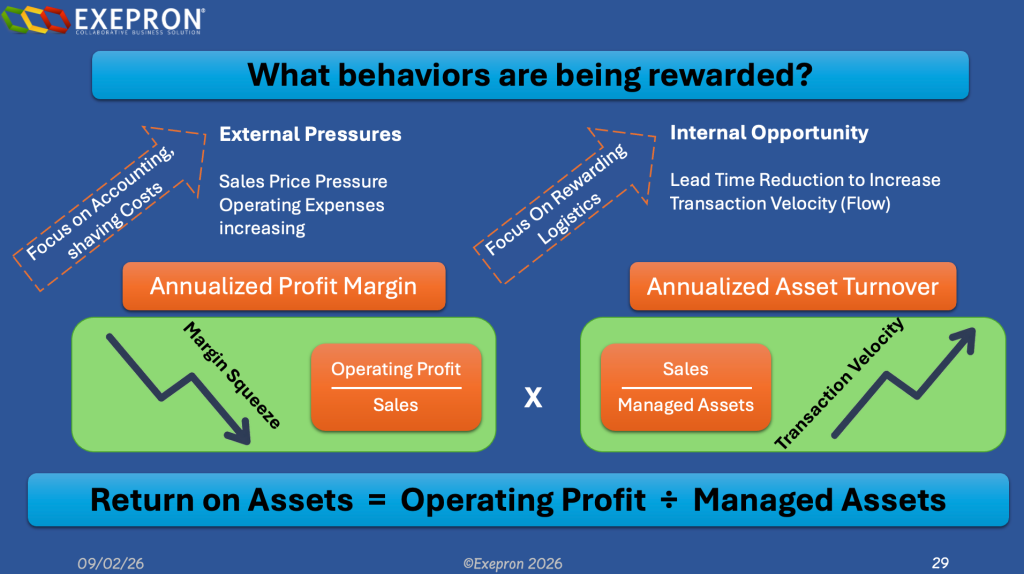
Before launching a transformation, leadership should ask:
- What global outcome are we trying to achieve?
- What behaviors are necessary to achieve it?
- What behaviors do our current measurements and rewards encourage?
- Where do local incentives conflict with the common goal?
- Who may lose income, status, authority, or perceived performance by supporting the transformation?
- How must rewards change to make the desired behavior rational?
Owners, executives, managers, and employees must be able to succeed through the same organizational outcomes.
When rewards are aligned with the common goal, sales become responsible for executable commitments—not simply captured orders. Pay sales commission on successful delivery, not order capture.
Project managers protect delivery and cash generation—not only project cost. Prioritize and stagger the Project Release and reward early intervention on critical priorities.
Product managers optimize the enterprise product mix—not isolated product margins.
Employees collaborate to improve system flow—not merely individual output. Reward innovation to maximize flow, not resource utilization.
If the strategy demands global collaboration while the reward system promotes local optimization, local optimization will win.
Define the goal. Establish shared measurements. Align authority and rewards.
Then transformation stops being something imposed on stakeholders and becomes the most rational path for everyone.
Contact Exepron and understand how this can be applied to your environment.
About the Author
John L. Thompson is COO and co-founder of Exepron and a practitioner of the Theory of Constraints with over 40 years of experience helping organizations improve flow, reduce lead times, and increase Asset Productivity.
email: JohnT@Exepron.com
Exepron: for Logistics-Driven Organizations.
Find out how to significantly reduce lead time and provide reliable delivery at exepron.com
Let’s explore if there’s a fit for your organization.
We invite you to test Exepron. We’ll bring the method, the technology, and the support. You bring the willingness to differentiate, retool operations, and lead cohesively.