Insights from an environment of high uncertainty.
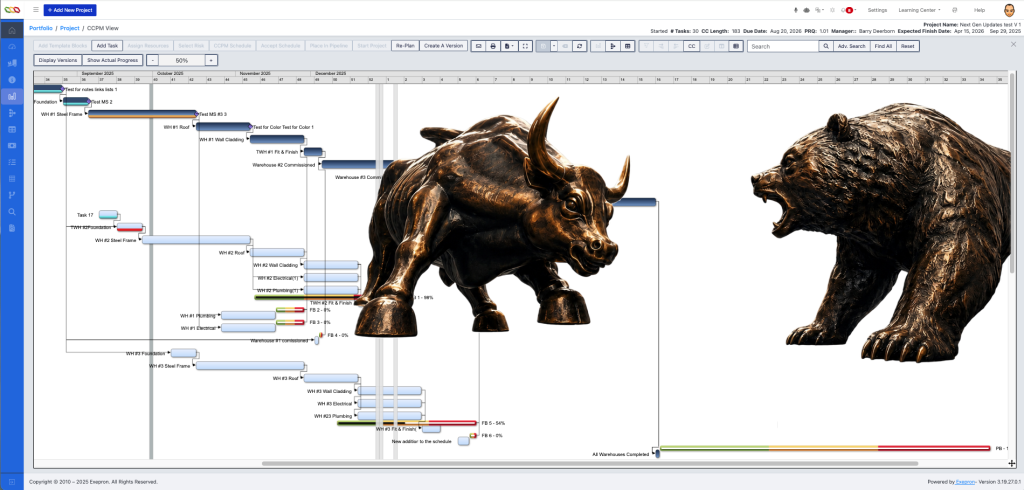
A financial journalist can write a confident story about what traders are “betting” will happen over the next two years. The story may sound logical. It may be supported by visible market positions. It may even persuade investors and the public.
But a professional trader knows something different.
The trader does not survive by defending a two-year forecast. The trader survives by reading signals, repricing probabilities, and changing course as the market provides new information.
That same distinction exists in project management.
The traditional project planner is often placed in the role of the journalist. The planner gathers available information, organizes the work, estimates durations, sequences tasks, and produces a plan that appears complete. The plan is then presented to executives, customers, investors, boards, and stakeholders as if it represents a reliable view of the future.
But the project plan is not the future.
It is a working hypothesis.
The operational project manager is in the position of the trader.
Once execution begins, the project is released into reality.
Tasks are started.
Resources are loaded.
Vendors are tested.
Drawings are questioned.
Approvals are delayed.
Priorities shift.
Materials arrive late.
Rework appears.
Policies interfere.
Management decisions change.
Customer requirements evolve.
Other projects compete for the same resources.
This is where certainty disappears.
A two-year project plan may look convincing in the boardroom, just as a two-year market forecast may look convincing in a financial headline. But the professonals responsible for execution know the truth. A plan is audited every day by reality.
The project plan sells certainty.
Execution reveals uncertainty.
This is why traditional project management so often struggles. It assumes that task durations, resource availability, dependencies, vendor performance, policy constraints, and management priorities can be predicted accurately enough to create a dependable task calendar commitment far into the future. In stable, repetitive production, that assumption has higher validity. In projects, especially complex multi-project environments, it does not.
Projects are not routine production.
Projects execute in environments of uncertainty, dependency, interference, and changing information. The greater the complexity, the more dangerous it becomes to manage the project as if the original plan is still a defendable truth.
In financial markets, new information is not considered an administrative inconvenience. It is a signal.
In projects, the same must be true.
A late start is a signal.
A missing full-kit is a signal.
An overloaded resource is a signal.
A supplier delay is a signal.
Rework is a signal.
Buffer consumption is a signal.
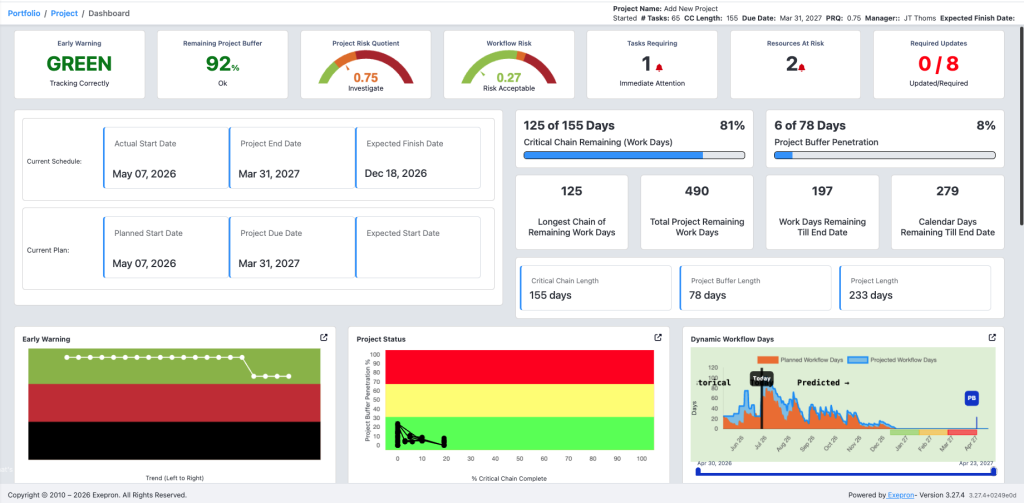
A rising Project Risk Quotient is a signal.
Excess WIP is a signal.
An “not updated” task is a signal.
Low update frequency is a signal.
The first question is whether the management system can detect these signals early enough to protect flow, delivery, and funding?
The second question is, what is management’s timely response to the signals?
This is where Critical Chain Project Management changes the operating logic.
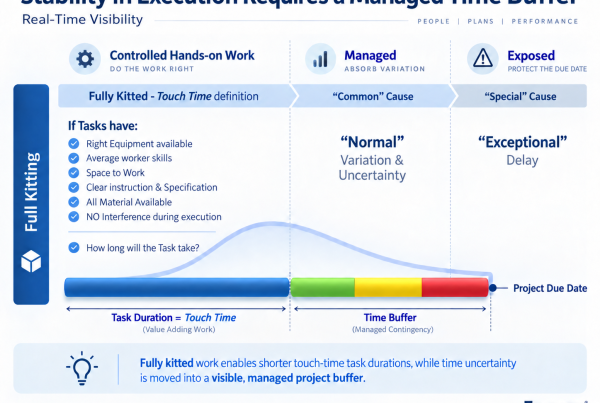
CCPM does not pretend that every task estimate is accurate. It does not hide safety inside individual tasks and then hope the project finishes on time. It recognizes that uncertainty is real, dependencies can be fragile, and resource contention is one of the greatest causes of project delay.
Exepron applies this logic directly to planning, scheduling, execution, to projects and portfolio management.
Planning
The initial plan is structured to confirm practical dependency logic, resource limitations, and the true sequence of work. Hidden task safety is removed and replaced with visible project and feeding buffers. Resource loading is made visible before execution begins. The portfolio is staggered relative to real capacity rather than releasing too much work into the system at once.
Execution
During execution, Exepron turns live project information into operational signals.
The operational project manager no longer has to defend yesterday’s plan. They can manage the uncertainty of today’s dynamic reality.
This is the difference between reporting history and managing the sustainment of a system.
Traditional project management often asks, “Are we still on the plan?”
CCPM asks a better question: “What is the system telling us now, and where must management act to protect commitments?”
That is the mindset shift.
A project planner may produce the original story. But the operational project manager must execute in the real environment. They must read the signals ahead of disruption, protect limited resources, manage WIP, act on buffer penetration signals, resolve resource contention, and escalate issues before they become delivery failures.
Executives also need to shift.
From Planning for Certainty to Managing Uncertainty.
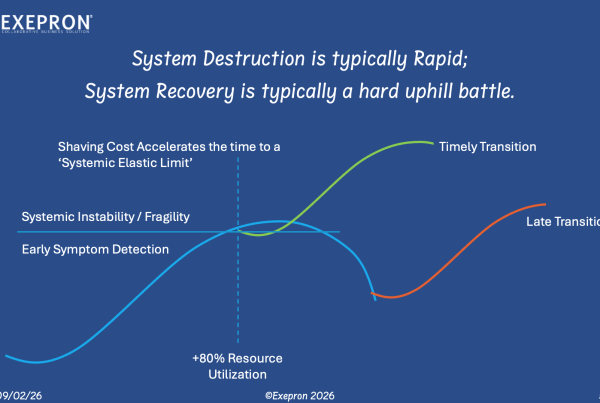
The purpose of a project plan is not to create the illusion of certainty. The purpose is to create a structure that allows uncertainty to be managed. Certainty may help sell the project, but execution performance depends on how fast the organization detects and responds to changing conditions.
A “sure bet” project plan may satisfy the approval process.
But once the project is released, reality becomes the auditor.
Exepron and CCPM provide the management system for that audit. They do not eliminate uncertainty. They make uncertainty visible, measurable, and actionable.
In projects, as in markets, the danger is not uncertainty.
The danger is defending the forecast after the signals have already changed.
CCPM means taking responsibility for progress.
Hidden safety, percentage-complete reporting, and constant replan revisions do not expose the real reasons projects slip. In reality, these behaviours hide them until a costly recovery is required. An invisible issue never has to be defended because it is never clearly seen.
CCPM changes that.
It makes the project’s actual current condition visible. It exposes missing full-kits, overloaded resources, excess WIP, late updates, buffer consumption, weak task handoffs, and management decision delays in real time.
This can be uncomfortable, because visible signals require ownership. But visibility is also what makes timely action possible.
Exepron and CCPM do not remove uncertainty from projects. They remove the illusion that uncertainty can be managed by hiding it within task estimates, defending outdated plans, or reporting progress as percentage completion, which does not reveal flow risk.
In projects, as in markets, the danger is not uncertainty.
The danger is pretending the forecast is still true after the signals have already changed.
CCPM makes the signal visible.
Exepron makes the signal actionable.
And once the signal is visible and actionable, we can no longer hide behind the plan. We must take responsibility for progress.
Contact Exepron here and understand how this applies to your environment.
About the Author
John L. Thompson is COO and co-founder of Exepron and a practitioner of the Theory of Constraints with over 40 years of experience helping organizations improve flow, reduce lead times, and increase Asset Productivity.
email: JohnT@Exepron.com
Exepron: for Logistic-Driven Organizations.
Find out how to significantly reduce lead time and provide reliable delivery at exepron.com
Let’s explore if there’s a fit for your organization.
We invite you to test the Exepron. We’ll bring the method, the technology, and the support. You bring the willingness to differentiate, retool operations, and lead cohesively.