The danger signals are visible before the collapse. Most organizations simply do not want to see it or name it.
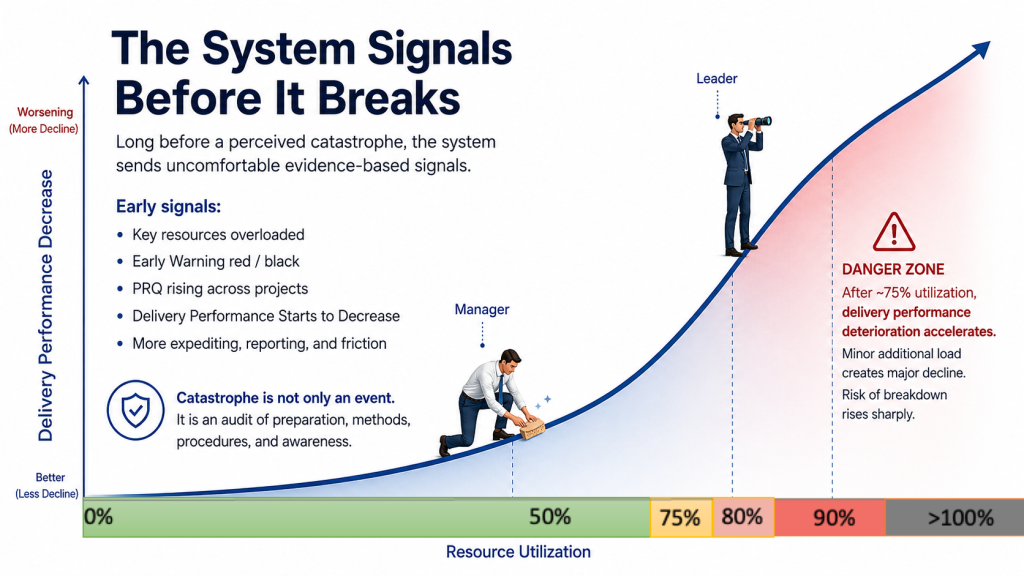
Long before a catastrophe, the system sends uncomfortable evidence-based signals:
- Key resources are overloaded.
- Early Warning turns red or black.
- PRQ rises across multiple projects.
- Delivery performance starts to decrease.
- Expediting, reporting, meetings, and friction increase.
- Local delays begin creating portfolio-wide damage.
These are not opinions. These are evidence worthy of investigation.
They are signals.
They tell leadership that the current operating model is no longer absorbing uncertainty. The system is not failing because people are lazy.
Systems fail because complexity, overload, and hidden assumptions have exceeded the organization’s ability to respond.
This is where leadership separates from management.
Managers in stable environments refine the existing procedures and polish the system.
Leaders in uncertain environments question whether the existing system still fits reality.
Managers ask: “How do we improve the procedure?”
Leaders ask: “What are the signals telling us that we have not yet admitted?”
If leaders are stuck, it is because their internal system is defending something they haven’t yet named.
Evidence-based signals help name the thing they are avoiding. We see the defense of:
- The organization is defending full utilization.
- Maybe it is unrealistic due dates.
- Maybe it is defending hidden safety in Tasks.
- Maybe it is incomplete customer specifications before release.
- Maybe it is defending releasing too much work-in-progress.
- Maybe it is defending probabilistic planning methods that look accurate but to ridgid survive operational uncertainty.
When Teams avoid the signals, they compensate by adding complexity.
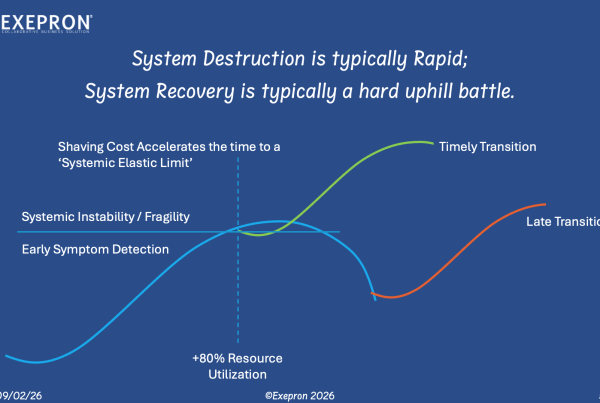
Tainters Ratchet, the bureaucracy of diminishing returns to the point of catastrophe.
- More reports.
- More meetings.
- More approvals.
- More controls.
- More procedures.
That is Tainter’s Ratchet inside the modern project organization: every local problem creates another layer, and every layer slows the system further.
Exepron and CCPM reverse the ratchet.
Exepron exposes the evidence early:
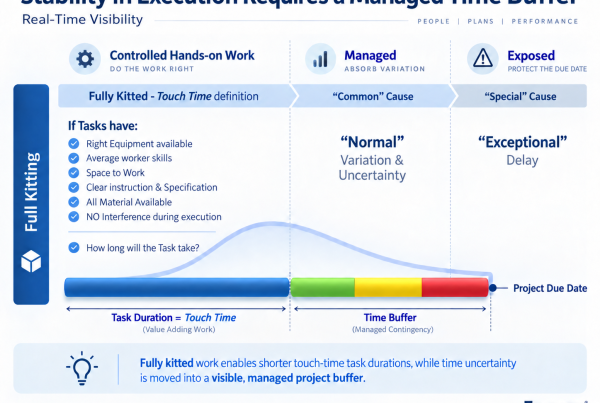
- Buffers show whether projects are still protected.
- PRQ shows whether risk is spreading.
- Early Warning shows when action is needed.
- Red Tasks highlight tasks requiring immediate attention.
- Reason Codes focus improvement efforts.
- Resource Heat Maps show where overload is damaging flow.
- The Dynamic Master Schedule prevents work overload from entering the system.
A catastrophe is a catastrophe with real casualties, but it is also an audit of your system.
- It is an audit of preparedness.
- It audits methods.
- It audits the structure.
- It audits procedures.
- It audits leadership’s awareness.
The leadership lesson is simple:
Do not wait for missed due dates to prove the system is broken.
By then, the damage is already financial.
The portfolio does not collapse all at once.
It bends first, Leaders must see around that bend. The signals are available, we must be willing to name them.
Contact Exepron here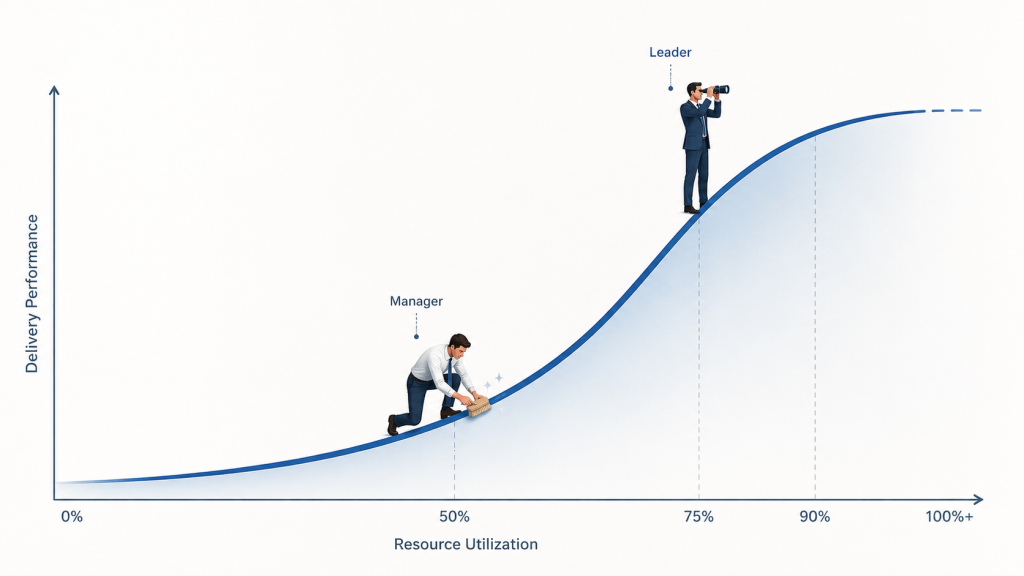 to understand how this applies to your environment.
About the Author
John L. Thompson is COO and co-founder of Exepron and a practitioner of the Theory of Constraints with over 40 years of experience helping organizations improve flow, reduce lead times, and increase Asset Productivity.
email: JohnT@Exepron.com
Exepron: for Logistic-Driven Organizations.
Find out how to significantly reduce lead time and provide reliable delivery at exepron.com
Let’s explore if there’s a fit for your organization.
We invite you to test the Exepron. We’ll bring the method, the technology, and the support. You bring the willingness to differentiate, retool operations, and lead cohesively.