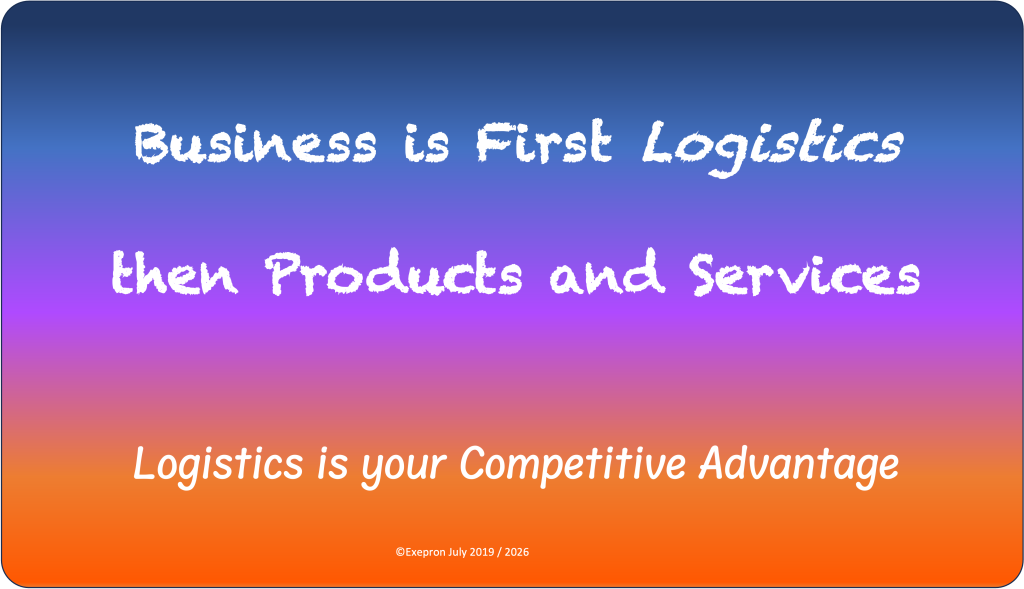
Many executives are aware of logistics as a function. Far fewer equate logistics as a primarily business equation, with product or service as secondary. Logistics is typically seen as external to the organization.
Companies often think in this sequence:
Sales → Product / Service → Delivery → Revenue
But operationally, the business behaves as a logistic equation:
Sales Promise → Capacity → Flow → Delivery → Trust → Cash → Improve
Delivery on promise does not discount the value of good products or services; it dramatically improves their value.
The real power of the product or service is realized only when delivered reliably, quickly, and profitably.
A great product or service, trapped by poor logistics, becomes a weak business.
The market does not only buy the product or service.
The market buys the delivered outcome.
Strategy:
This is where project portfolio management becomes a strategic discipline.
Your Scheduling and Project Portfolio performance is your Strategy in action.
It is not the Strategy written in the slide deck, or the Strategy described at the annual meeting.
Real strategic capability is revealed by what the organization starts, protects, delays, interrupts, funds, staffs, and finishes.
If the workflow is overloaded, conflicted, late, and constantly reprioritized, then the operating strategy is the hopeful good intentions of “growth,” “customer focus,” or “operational excellence.”
The normalized strategy has become:
Start too much.
Finish too little.
React constantly.
Protect local priorities.
Hope the system absorbs the damage.
That is not an intentional strategy, but it can become the default strategy.
This is why strong internal operating logistics matters.
Despite operational complexity, the organization must know:
What should start.
What should wait.
What is ready.
What is not ready.
Where capacity is overloaded.
Where flow is blocked.
Which promises are at risk.
Which projects actually move the company forward.
Products and promises create demand; logistics sustains demand.
Logistics converts demand into cash, trust, and repeat business.
And in business, where delivery performance is one of the clearest mirrors of whether strategy is being fulfilled, is executable, and economically viable.
The market buys the delivered outcome. Everything else is a good intention.
The operational complexity is beyond human scheduling mastery; it requires an intelligent digital partner to meet the dynamics of dem
Contact Exepron here and understand how this applies to your environment.
About the Author
John L. Thompson is COO and co-founder of Exepron and a practitioner of the Theory of Constraints with over 40 years of experience helping organizations improve flow, reduce lead times, and increase Asset Productivity.
email: JohnT@Exepron.com
Exepron: for Logistic-Driven Organizations.
Find out how to significantly reduce lead time and provide reliable delivery at exepron.com
Let’s explore if there’s a fit for your organization.
We invite you to test the Exepron. We’ll bring the method, the technology, and the support. You bring the willingness to differentiate, retool operations, and lead cohesively.