AI is changing how businesses plan, analyze, and make decisions. Yet a core residue of management elements remains true. Better technology can improve decisions, but their validity still depends on the operating principles underlying those decisions.
There is a list of practical operational First Principles in the appendix below:
The cost-cutting vs. asset productivity battle is at the core of the operational metrics battle. Promoting flow is the direction out of this dilemma.
Anti-Flow
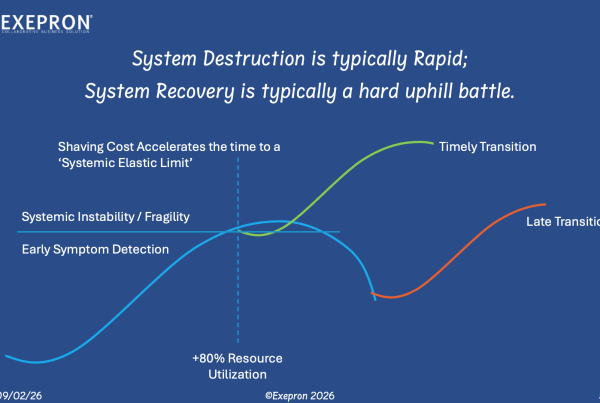
Metrics that balance capacity, promote local efficiency, reward locally, apply internal transfer pricing, and cost-cutting stretch capacity, driving the company closer to a capacity ‘elastic limit’. Instability increases: Symptoms include increased overtime, longer and less reliable delivery lead times, more expediting, and more. Minor operational decisions escalate to senior management for attention.
Promoting flow, lead time reduction, and asset productivity.
Work depends on upstream work. Resources have limited capacity. Variability disrupts plans. A delay in one operation can hold up several others. These relationships govern both internal execution and the external movement of materials, services, and finished products. Ignoring systemic dependency in measurement and reward systems blinds every independent function to the downstream impact.
GAAP promotes local independent metrics; Total Asset Performance promotes organization-wide performance.
Planning and rewarding in isolation
Consider a business that releases more projects in an attempt to accelerate growth. Each project appears commercially justified. Each department works harder. Yet these projects compete for the same engineers, equipment, suppliers, and management attention.
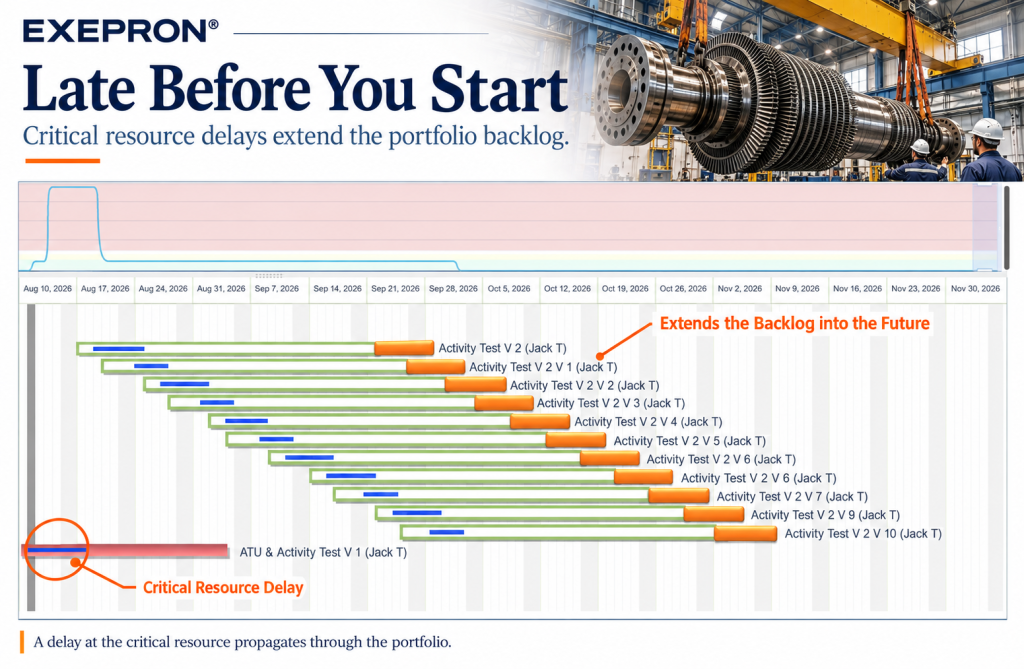
Queues grow, priorities change, and delivery slows. The company has increased activity while extending the time required to earn revenue. Any minor delay on a minor task has the potential to delay a successor task utilizing a scarce and critical resource. When delays shift to a future critical resource, this shift can delay every current and future order and every project.
The breakthrough is managing the flow of the whole system.
A current constraint governs how much of the current work mix the business can complete. Releasing work faster than that constraint can process creates congestion. Increasing capacity in a non-constrained department may simply move work into a longer queue. More WIP.
Management therefore needs a different decision rule: release work at a pace the system can sustain, protect the resources that govern delivery, and focus attention, then reward and invest where intervention can improve the overall result.
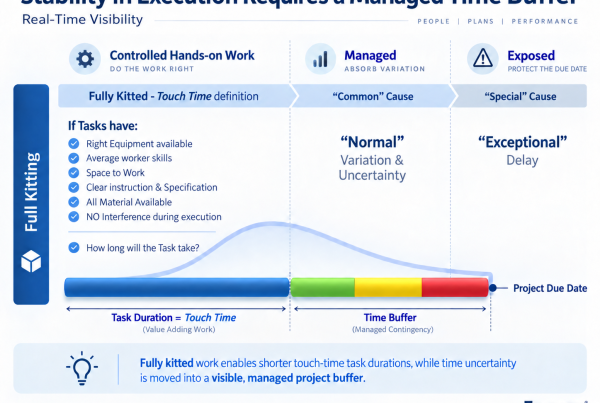
Variability also requires explicit protection. Traditionally, every task and work center carries its own hidden allowance for variation; therefore, managers struggle to distinguish normal variation from a developing threat. Visible, systemic, actively managed time buffers make system protection measurable. Buffer consumption helps reveal whether delivery remains secure and where action is becoming necessary.
Does CCPM follow First Principles?
Any effective application must apply these principles. Critical Chain Project Management provides the best means of managing capacity, uncertainty, and risk. Master Schedule staggers project starts against shared resource capacity. Feeding and project buffers protect delivery. Remaining-duration updates and early warnings reveal emerging criticality. Management can then focus on the critical few tasks and resources affecting portfolio performance. A minor delay can have significant consequences for the whole portfolio of work.
The business implication reaches beyond scheduling.
Shorter, more reliable lead times can bring revenue forward, reduce expediting, lower cost, and allow existing capacity to complete more valuable work. Those benefits depend on demand and commercial conditions, but they begin with the same operating requirement: reliable flow.
AI strengthens management when it helps detect and address these conditions sooner. Its contribution is greatest when guided by sound principles.
Before investing in more capacity, ask:
What currently limits completion, what protects these resources from disruption, and which decisions will improve flow toward the business goal?
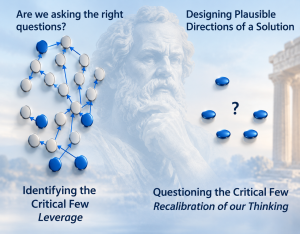
Breakthrough requires some recalibration of current thinking and policy.
If you would like to explore practically applying first principles to your operations, contact the author here: JohnT@Exepron.com
Appendix:
Here’s a summary of first principles that promote and maximize flow.
1. A Systems Perspective: The Project and Portfolio as a Closed System
CCPM treats projects in a portfolio as closed systems, shielded from external disruptions by protective time buffers. These buffers absorb uncertainties while dynamic penetration activates indicators to track task delays, ensuring timely interventions. Timely intervention maintains buffer integrity, keeping this structured isolation from derailing project progress due to external interference.
2. Simplicity: The Best Solution Minimizes Fuzzy Assumptions
CCPM removes hidden safety margins from within task durations by consolidating protective time into visible buffers. This preparation ensures projects can absorb variation while prioritizing intervention. Full kitting ensures tasks start only when fully prepared—materials, resources, approvals, and workspace in place—resulting in accurate planning, reduced inflation, and real-time adaptability to variation.
3. Frequent Task Updating Provides Real-Time Decision Intelligence
CCPM emphasizes high-frequency task updates, no more than two days apart, to maintain real-time visibility. This approach prevents minor issues from escalating and enables proactive decision-making based on current project conditions, not outdated reports. Preventing minor delays keeps downstream critical and scarce resources from causing further delay across the portfolio.
4. Reducing Degrees of Freedom by Full Network Dependency
By ensuring proper task sequencing and milestone placement, CCPM prevents fragmented execution. Projects follow a streamlined, dependency-driven structure, tracking variability and ensuring predictable task progression. Building right to left, applying necessary and sufficient rules confirms project integrity.
5. Applying Best Current Knowledge
CCPM separates dependency coordination from subject matter expertise. Project managers rely on SMEs to define task dependencies and build networks from the objective right to left. This method prevents redundant reinvention, ensuring project structures reflect the best available knowledge. The role of the PM is coordination.
6. Avoiding Reinvention: Using Templates and Analysis
CCPM promotes efficiency through standardized templates, proven workflows, and effective project data. This approach reduces planning effort while maintaining flexibility for customization. Reason Code analysis helps identify future risks and refine project execution strategies. Reason Codes provide data for continuous improvement.
7. Every Action Has an Immediate Reaction
Borrowing from Newton’s third law, CCPM triggers corrective actions when buffers are violated. This rapid response ensures that interventions are timely, cost-effective, and proportional to the potential project impact. Giving priority to critical resources and threatened due dates.
8. Actionable Metrics for Proactive Management
CCPM replaces arbitrary deadlines with objective, buffer-based metrics. Key indicators like Work-in-Progress (WIP), buffer health, early warning, and projected resource loading provide real-time insights, ensuring managers focus on tasks that truly affect project and, importantly, portfolio success.
9. Immediate Intervention Stops Compounding Recovery Costs
CCPM emphasizes swift problem resolution to prevent escalating recovery costs. Real-time task updates and buffer penetration alerts allow managers to intervene before minor issues snowball into significant and costly delays.
10. Removing System Constraints for Continuous Improvement
CCPM integrates the Theory of Constraints (TOC) to identify and resolve project limitations. By applying the Five Focusing Steps to prioritize the iterative removal of limitations, organizations can achieve sustainable project efficiency while ensuring short payback periods on operational improvements that drive high profitability.
11. The Accuracy of Predictions Rapidly Deteriorates Over Time
CCPM recognizes the diminishing accuracy of long-term forecasts. Instead, it prioritizes real-time data, short-term updates, and agile decision-making to ensure project adjustments align with current realities.
12. Asking the Right Questions for Actionable Intelligence
CCPM enhances project success by focusing on questions aligned with scope, schedule, and budget. Leading indicators, such as buffer consumption, WIP compounding, identifying critical resources delaying a portfolio, and resource heat maps, enable proactive decision-making and timely course corrections for projects, portfolios, and investments.
13. Small Degrees Compound Over Time
CCPM highlights the cumulative impact of both errors and successes. Timely corrective actions compound positively; delays magnify project instability. Consistently following CCPM principles ensures continuous improvement and predictable outcomes.
Contact Exepron and understand how this can be applied to your environment.
About the Author
John L. Thompson is COO and co-founder of Exepron and a practitioner of the Theory of Constraints with over 40 years of experience helping organizations improve flow, reduce lead times, and increase Asset Productivity.
email: JohnT@Exepron.com
Exepron: for Logistics-Driven Organizations.
Find out how to significantly reduce lead time and provide reliable delivery at exepron.com
Let’s explore if there’s a fit for your organization.
We invite you to test Exepron. We’ll bring the method, the technology, and the support. You bring the willingness to differentiate, retool operations, and lead cohesively.